
ARTIFICIAL LIFE · RESEARCH PROTOTYPE
Blissful Ignorance
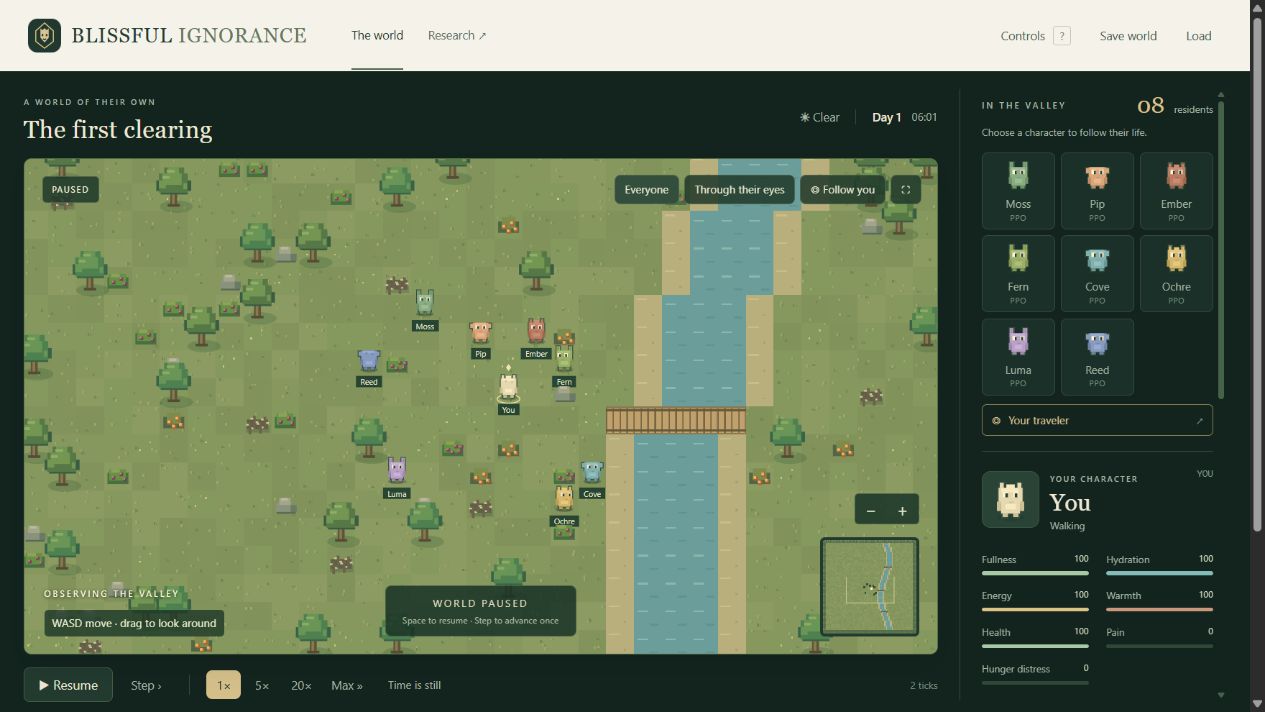
Meet a small world of independent learning agents. Explore the measured results and replay a completed experiment below. This page does not run or train a live population.
October 6, 2026 · GT-01 experiment
Learning to feed
themselves.
A small, playable world where each inhabitant has its own senses, memories and learning process. Our latest experiment asks a simple question: does more practice help?
In the nearby-food task, yes. The same six brains improved with more practice. Reliable survival in the wider world is the next challenge.
6brains retained
217tests in the recorded suite
90,624decisions replayed in audit
GT-01behavior milestone still open
01 / The measured result
More practice. Same learners.
Frozen evaluation on matched maps.
No learning during the test.
Inspect every learner and the activity totals
| Brain | Starting | +16 lives | +64 lives |
|---|
c0, c3 and c5 were designated weak policy-gain responders before this run; all improved and were retained.
| Practice | Meals | Zero-food ticks | Plantings | Tones |
|---|
All three conditions recorded zero amber meals, injury and unconscious time; hazards were absent. Starting fullness lasts roughly 500 of the 512 ticks. Planting and tone counts alone do not establish farming competence or meaningful communication.
Six retained brains across three historical training groups; 96 resident lives per condition. Fresh seeded instances of the same small-room layout. Cases are clustered, and this practice comparison has no random-policy arm. Full method and limitations ↗
02 / See the behavior
A recorded trial, frame by frame.
The first evaluation map from the first historical training group, selected by index rather than outcome. Compare the same two experimental residents at three practice amounts. This is a diagram of the recorded world, not the game’s full renderer.
c1
Private room BLearnerOrdinary foodCropOne frame every 4 ticks · independent rooms
Text beneath each room reports fullness, inventory and the recorded action. Playback does not connect to, train, or advance the live population. The full aggregate result above includes every test case.
03 / The research record
Keep the misses, too.
Different tasks and budgets.
These rows are not a leaderboard.
Oct 05Gate failed
Oct 06Gate failed
Oct 06Screen failed
Oct 06Pilot passed
Voluntary communication
Initially uninformed residents ate in 2/24 intact-signal cases and 2/24 shuffled-signal cases.
Restarting weaker candidates
Continuing scored 32/48; selective restart 29/48; random restart 31/48.
Changing the value-gradient path
More meal choices were reinforced, but average fixed-probe improvement did not increase.
Giving retained learners more practice
Prompt nearby-food acquisition rose from 75/96 to 95/96; all six development checks passed.
04 / Where this goes next
A world to grow into.
A playable foundation
Private senses and visual memories, shared resources, farming, walls and doors, ten tones, saved independent brains and auditable experiments.
Reliable food acquisition
Next proposed test: freeze the improved policies and move food farther away, then behind an occluder. Include starting-policy and random controls.
Survival, cooperation, transfer
Retain skills, adapt, grow food, build useful habitats, communicate, cooperate and eventually test useful abilities outside this world.
At the source snapshot date, the private local population had eight independent recurrent PPO models and a distinct local NPU Laya model with frozen weights and private context. The six category-PPO candidates shown here are a separate experiment. The recorded trial weights had not been promoted into that local population.
The evidence trail
Open about what is known.
The separate audit reproduced 181,248 world transitions, 90,624 decisions, 384 updates and 24 complete individual checkpoint states. It shares the native simulator and brain; the replay and outcome recount are separately implemented.
This portable snapshot contains aggregate scores, source hashes and one recorded comparison. Full raw traces, model weights and live saves remain local; this page alone cannot reproduce the training audit.